Living and Philosophical Logic: Starting from a Glass of Water, a Conversation on the 3D Atomic Model of Systems
Our lives are constantly shaped by two interconnected dimensions: the physical execution layer (hardware) and the mind's spiritual consciousness (software).
Philosophy is not an abstract ivory-tower exercise; it is a systematic thinking tool that explores reality through repeatable processes, verifiable paths, and reproducible methods.
An ultimate premise: Philosophy must be rooted in everyday living. Without real human needs and authentic actions, true philosophy cannot exist—without life, there is no philosophy.
Introductory Inquiry: If you don’t have water and want a cup of water, what happens?
🤔 Thought Experiment: The Physical State Transition Constraints Behind Daily Actions
\"If I have no water in hand, want to pour a glass without spilling, my necessary first action must be taking a cup, moving to the dispenser, and filling it. A full cup cannot suddenly appear out of thin air.\"
Logic as Objective Boundary: If a filled glass suddenly appeared without picking up a container and pouring water, it would violate temporal causality and physical transition laws—meaning it violates logic. Our everyday existence operates seamlessly on strict philosophical foundations.
🏛️ 1. The Three Pillars of Philosophy Mapped to Living Systems
The three classical branches of philosophy—Epistemology, Logic, and Aesthetics—directly govern how daily life and complex software/hardware systems operate:
| Philosophical Pillar | Core Inquiry | Practical Expression in Systems & Life | Symptoms When Broken (Bugs) |
|---|---|---|---|
| Epistemology | How do we know this fact to be true? | Source of Truth & Starting Point: Single Source of Truth, sensor validation, fact-checking. | Misinformation, dirty data decisions, untraceable root origins. |
| Logic | Does the causal sequence match physical reality? | State Transitions & Causality: Pre-conditions must be fulfilled before state mutations occur. | Race conditions, skipped validation, unpredictable phantom states. |
| Aesthetics | Does an entity evoke mental harmony and order? | Simplicity & Low Cognitive Load: Elegant UI, clean modular code, structured documents. | Cognitive overload, user friction, bureaucratic resistance. |
From these intersections, we extract the five essential pillars of any living system:
System, Habit, Institution, Structure, Incentive
⚛️ 2. The 3D Atomic Model of Systems
Representing these five elements as a flat checklist misses their underlying dynamics. In reality, they interact like a dynamic 3D Atomic Model:
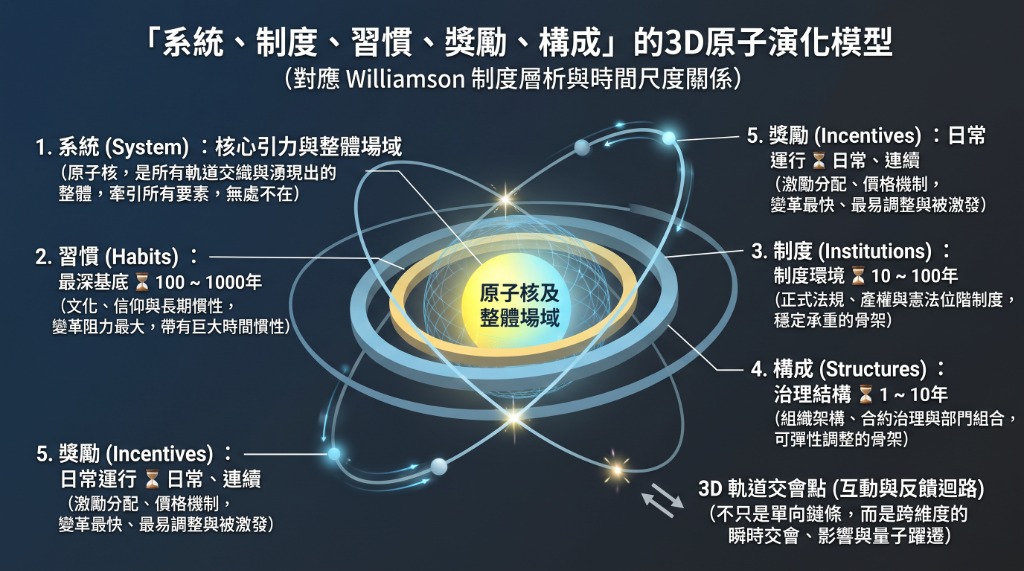
Figure 1: Multi-dimensional Atomic System Model — Central Gravitational Core and 4 Time-scale Orbits
1. System: The Nucleus and Gravitational Field
The “System” is neither a distant rooftop nor a rigid diagram. It acts as the central dense nucleus and pervasive gravitational field. It defines boundaries, aligns ultimate objectives, and exerts pull to keep outer orbits in harmonious orbit.
2. Orbits as Energy Bands Across Time Scales
| Orbital Layer | Position & Metaphor | Time Scale / Half-life | Dynamic Properties |
|---|---|---|---|
| Habit | Innermost Orbit (Deep Foundation) | 100 ~ 1000 Years | Heavy, massive, highly resistant to relocation. Carries cultural inertia. |
| Institution | Middle Structural Orbit (Rules/Environment) | 10 ~ 100 Years | Load-bearing skeleton: legal frameworks, property rights, constitutional rules. |
| Structure | Sub-middle Modular Orbit (Governance) | 1 ~ 10 Years | Modular governance: departmental organization, agile team architectures. |
| Incentive | Outermost Orbit (Daily Electron Stream) | Continuous / Daily | Ultra-lightweight, rapid electron flow. Instantly excited, feeding signals inward. |
Fundamental Law: A true “System” is the emergent dynamic synthesis of these four overlapping orbits. If any ring is severed, the system destabilizes.
🌌 3. Williamson’s Institutional Levels and Quantum Leaps
Oliver Williamson’s Nobel-winning Four Levels of Social Analysis is dynamicized within this 3D model:
- Level 1 (Habits/Culture, 100-1000y): Innermost orbit.
- Level 2 (Institutions/Law, 10-100y): Structural orbit.
- Level 3 (Governance/Contracts, 1-10y): Agile organizational orbit.
- Level 4 (Incentives/Prices, Daily): Rapid electron energy flow.
Cross-dimensional Quantum Leaps
Because orbits are inclined in 3D space, they intersect at sparkling luminous nodes. When the outermost incentive orbit reaches critical kinetic energy, it triggers a quantum leap directly exciting the innermost habit orbit, transforming foundational culture without being bottlenecked by traditional linear bureaucratization.
Summary
Life tests philosophy; philosophy deconstructs life. A powerful system is not an inert chart on the wall, but a high-energy atom spinning across space-time dimensions. When Epistemology safeguards truth, Logic preserves causality, and Aesthetics grants order, our systems thrive with enduring vitality.