The Alchemist’s Antique Shop: From Dual Exchange to the Accounting Equation’s Mystery of “Creation and Holding”
Before we discuss e-commerce, information systems, or modern complex ERP, the same language flows beneath all business: accounting. Many people memorize debits and credits yet find it tedious and boring. This article will take you back to an ancient story, using a fresh "cash flow philosophy" to deconstruct the accounting formula you thought you already understood.
A Village Story About “Trust, Promise, and Substance”
In a coastal village far from the hustle and bustle, there lived a respected craftsman named Al. Al wanted to open an “antique restoration shop” that could repair villagers’ memories. But he faced the same challenge every entrepreneur encounters: he didn’t have enough resources.
One day, the village elder (or his parents) walked into his workshop, patted him on the shoulder, and said: “Al, I believe in your craftsmanship. Here are two hundred gold coins to support you—use them to expand your workshop. Consider this money my investment in you as a person.”
Then, a nearby timber merchant arrived with a cart full of precious cypress wood: “I know you’re tight on cash right now. Take this hundred gold coins worth of lumber and use it. After you make furniture and sell it, pay me back next month.”
Al looked at the two hundred gold coins from the elder on his workbench and the hundred gold coins worth of lumber in the backyard, lost in thought.
At this moment, what happened in Al’s shop? From a spatial perspective: Al “holds” two hundred gold coins and lumber worth one hundred coins—a total of three hundred gold coins in resources. From a time and relationship perspective: Did these three hundred coins appear out of thin air? No. They originated from the elder’s “trust (equity)” and the timber merchant’s “promise (liability).”
This is the starting point of business. Without those intangible trusts and promises, physical resources wouldn’t gather in this space.
Mathematical Transposition: From Static Balance to the Dynamic Double Helix
In the initial world of accounting, scientists and merchants recorded Al’s shop with the most primitive formula:
What you have on hand = What you owe others + What you truly own
In business terms: Assets = Liabilities + Owner’s Equity In short: A = L + S/E
In this formula, the left side represents what Al currently “has” (coins and lumber); the right side represents “where these things came from” (the timber merchant’s IOU and the elder’s investment). At this point, the formula is static—like a snapshot taken at a specific moment.
However, once the antique shop opens and time begins to flow, the story changes.
To keep the shop running, Al must light the fire, hire apprentices, and pay for daily advertising (money spent) (Expense, E); meanwhile, he repairs antiques for villagers and earns compensation (money earned) (Revenue, R).
These business activities directly affect the initial value of the elder’s investment (owner’s true equity). Thus, the formula evolves into a dynamic extended form:
What you have = What you owe + (Owner’s original money + Earned - Spent)
Now, mathematical magic happens. To make the formula visually and logically easier to manage, we move the subtraction term (-E) from the right side to the left side through transposition:
A + E = L + S/E + R
This transposition isn’t just moving mathematical symbols—it profoundly defines the “left and right side rules” of modern bookkeeping:
Left side of the equation: When “what you have” and “what you spent” increase, we record it on the left. Right side of the equation: When “what you owe,” “owner’s money,” and “money earned” increase, we record it on the right.
(In accounting, the left side is called “Debit” and the right side is called “Credit,” but you only need to remember: “left is destination, right is source.”)
Why Is the Left Side Called “Debit” and the Right “Credit”? A Five-Hundred-Year Misunderstanding
Many people mistakenly interpret “Credit” as “creation” and “Debit” as “holding.” But if we trace back to accounting’s historical origins, the truth is simpler:
- Left side (Debit): Originally meant “owed to me” or “what should be given to me”
- Right side (Credit): Originally meant “trust,” “entrust,” or “what others gave me”
Although the literal meanings aren’t creation and holding, if you view it from “the flow of money,” you’ll discover a profound philosophy:
The right side is the “source” of money: Whether borrowing from others, owner investment, or business earnings—all represent funds given to the shop from the outside. It “creates” the possibility for the shop to operate.
The left side is the “destination” of money: After the shop receives funding sources from the right, it must convert them. If kept in the account or used to buy equipment, it becomes “assets on hand”; if used to pay wages or buy materials, it becomes “expenses spent.”
Core concept: Use the “IOUs and trust” from the right to create the “actual holdings and operating expenses” on the left. This concept is crucial when building any business or system.
🎨 Visualization: A Philosophical Map of the Accounting Equation
To make this abstract concept more concrete, we use visual charts to present the “accounting philosophy card,” clearly showing the relationship between the left and right sides:
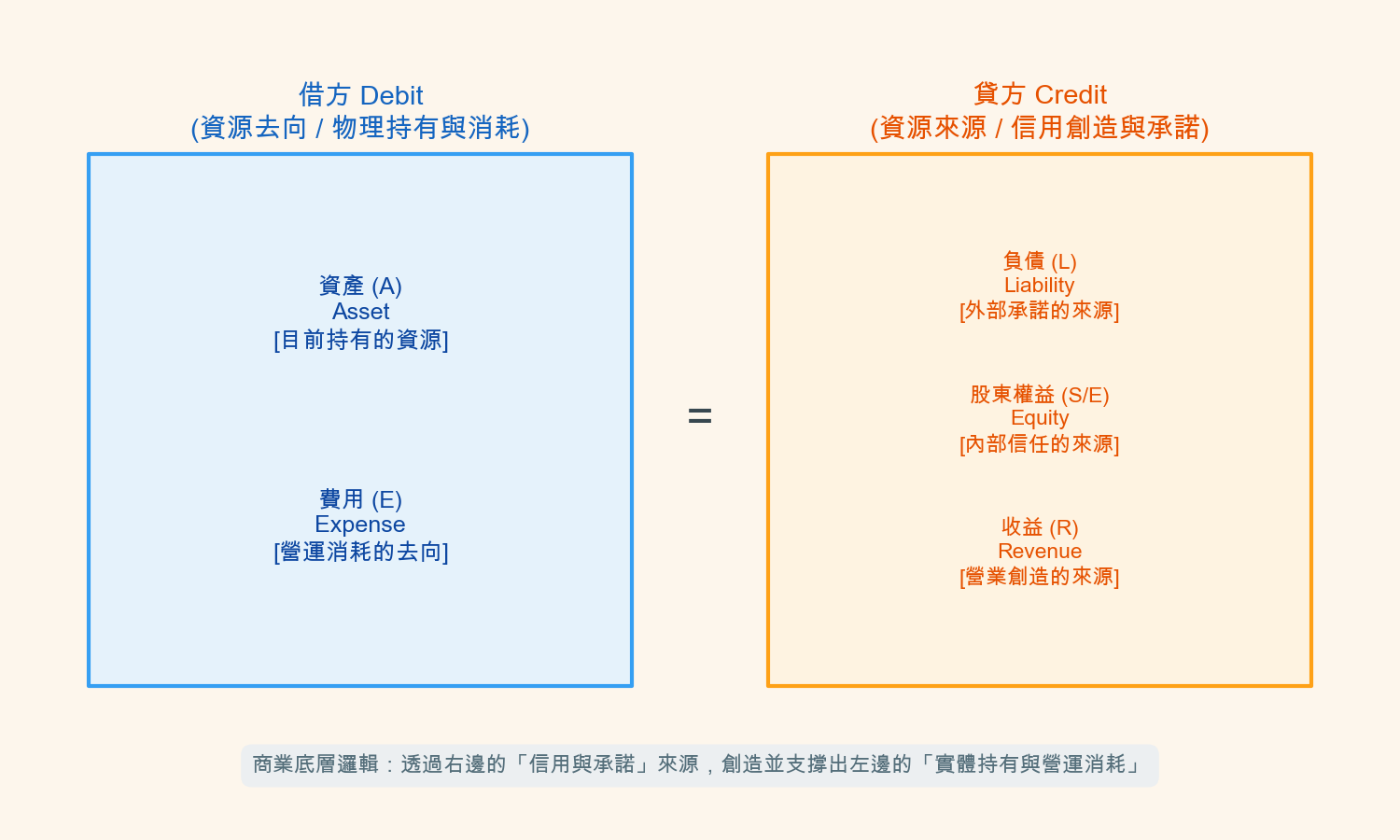
This chart clearly illustrates the core philosophy of the accounting equation: the blue area on the left represents "where resources go" (Assets Held + Expenses Consumed), while the orange area on the right represents "where resources come from" (Liability Promises + Equity Trust + Revenue Creation). The equals sign in the middle symbolizes eternal balance—every dollar's source must have its destination; every dollar's destination must have its source.
🎮 Interactive Exercise: Experience Debit-Credit Balance Hands-On
Now, let’s use a cute interactive tool to experience the balance principle of the accounting equation firsthand! Try entering numbers in any field, and the system will automatically prompt you on how to balance the equation and explain possible business scenarios.
• Try entering 100 in the "Assets" field and see what the system prompts!
• Challenge: Simulate Al's transaction of buying $100 worth of lumber on credit from the timber merchant (Hint: Assets +100, Liabilities +100)
• Advanced: Try creating a transaction that includes both revenue and expenses, and see if you can make a profit!
Three Important Details
When you want to apply this story and logic to real business, pay attention to these three key points:
1. Owners May Take Profits (Dividends)
In our derivation above, we assumed all earnings stayed in the shop. But in the real world, owners (or shareholders) may request dividends. When the shop distributes earnings to owners, it reduces “what the owner truly owns” on the right side.
2. The Timing of Spending and Paying May Differ
In the story, the timber merchant allowed credit—this is very common in business. The important point: spending (expense incurred) and paying (cash outflow) don’t necessarily happen simultaneously.
Example: Al buys a precision machine for antique restoration. This machine gradually wears out over time. The decrease in the machine’s value is a type of “expense,” but this expense doesn’t require additional payment.
3. Both Sides Happen Simultaneously, Not Sequentially
Beginners often think “because there was money on the right, we later bought things on the left.” But in bookkeeping systems, every transaction is a “simultaneous” mirror: the moment you purchase materials on credit, the system records both “left side asset increase” and “right side debt increase” at exactly the same time.
💡 Summary: The Essence of the Accounting Formula
Through this story of Al’s antique shop, we discover:
The accounting formula isn’t a mathematical game—it’s a logical framework humans created to capture how the “world of trust” and the “physical world” interweave and operate.
- Right side (Credit) = Where money comes from: Others’ trust, one’s own investment, business earnings
- Left side (Debit) = Where money goes: Assets on hand, expenses spent
- Equals sign = Always balanced: What comes in equals what goes out; nothing disappears into thin air
Next time you see a complex financial statement, try imagining Al’s antique shop. Behind every number is a small story about trust, promises, and resource flow.
When you start a business, you don't have money first and then act—you have "trust and promises" first (right side), which then converts into "actual resources" (left side). This is why the hardest part of entrepreneurship isn't technology—it's building trust.